Blog > Billing and Insurance > Behavioral Health Utilization Review: Documentation Tips, Templates & Sample Language
Behavioral Health Utilization Review: Documentation Tips, Checklist & Free Template
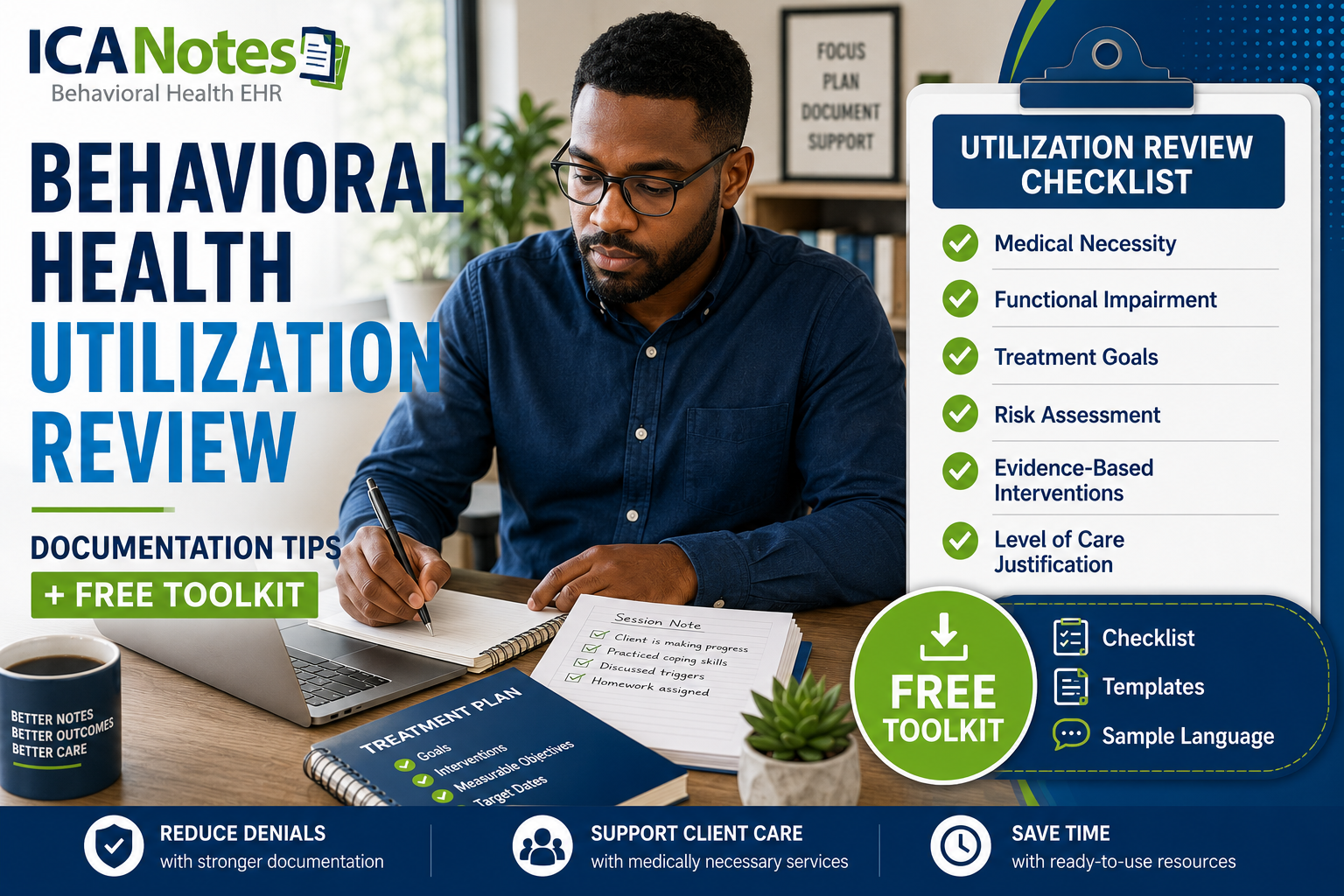
Learn how to pass a behavioral health utilization review with practical documentation tips, utilization review examples, medical necessity guidance, and a free downloadable toolkit. This comprehensive guide covers prospective, concurrent, and retrospective reviews, including utilization review checklists, templates, sample note language, and documentation strategies for outpatient, IOP, and PHP programs. Whether you're preparing for a concurrent review, documenting medical necessity, or appealing a denial, you'll find the tools and examples needed to reduce denials and support continued care.

Last Updated: June 11, 2026
Key Takeaways
- Utilization reviews evaluate medical necessity based on what is documented — not what was discussed in session.
- Functional impairment language is one of the most important factors reviewers consider.
- IOP and PHP programs require explicit level-of-care justification to support authorization requests.
- Measurable progress — or a documented clinical reason for lack of progress — is essential for concurrent reviews.
- The free Utilization Review Documentation Toolkit includes checklists, templates, sample language, denial rebuttals, and an appeal letter template.
Contents
- Why Clinical Documentation Matters for Utilization Review
- Tips for Documenting with Utilization Review in Mind
- Utilization Review Tips for IOP and PHP Programs
- Utilization Review Documentation Checklist
- Utilization Review Best Practices
- How ICANotes Supports Documentation for Behavioral Health Utilization Reviews
- FAQ: Behavioral Health Utilization Review
- Final Thoughts on Behavioral Health Utilization Review
Mental health clinicians are no strangers to the frustrating dance of insurance authorizations. A behavioral health utilization review can feel like an administrative hurdle — but it’s actually your opportunity to clearly demonstrate the medical necessity of your client’s treatment. Good documentation doesn’t just protect your client’s care. It protects your time and income, too.
Whether you’re working in outpatient therapy, an intensive outpatient program (IOP), or a partial hospitalization program (PHP), the strategies in this article will help you document with confidence, reduce denials, and navigate reviews at every level of care.
What Is a Utilization Review in Behavioral Health?
A behavioral health utilization review is the insurance company’s process for determining whether the services you’re providing, or planning to provide. are medically necessary. Reviews may occur at different points in the treatment episode, and each type has its own documentation requirements.
Prospective Review (Pre-Authorization)
Also called prior authorization, a prospective review happens before treatment begins. The insurer evaluates whether the proposed level of care and service frequency are medically necessary. Strong prospective documentation should clearly establish the diagnosis, current functional impairment, and the clinical rationale for the requested level of care. Weak documentation at this stage is the leading cause of authorization denials before treatment even starts.
Concurrent Review
Concurrent reviews happen while treatment is ongoing, typically at set intervals or when authorizations are up for renewal. Reviewers want to see that the client is making measurable progress — or that there is a clear clinical reason why progress is limited. They will also check that your treatment plan has been updated to reflect the current clinical picture. Stale goals and copy-pasted notes are major red flags at this stage.
Retrospective Review
A retrospective review happens after services have been rendered. These often occur during payer audits or when a claim is flagged for review. Because there is no opportunity to update documentation after the fact, the quality of your real-time notes is everything. Strong retrospective documentation is simply the byproduct of writing strong notes from the start.
Understanding the differences between prospective, concurrent, and retrospective reviews can help clinicians document more effectively and avoid authorization delays.

Why Clinical Documentation Matters for Utilization Review
In behavioral health, your clinical judgment may be excellent — but if your documentation doesn’t reflect it, payers may still deny care. Utilization review decisions are based solely on what is documented, not on what was said or implied during a session. Even the most effective therapy can be deemed not medically necessary if your notes don’t tell a clear, specific story.
When documentation is vague, repetitive, or disconnected from the treatment plan, it raises red flags for reviewers. Common documentation problems that lead to denials include:
- Using general language like “talked about stress” without tying it to functional impairment
- Repeating the same note structure across sessions without showing progress or reassessment
- Failing to update treatment plan goals or interventions when the client’s condition changes
- Noting risk factors without documenting a specific clinical response
These lapses can result in denied authorizations, delayed payments, or — worst of all — interrupted care for your clients. By contrast, clear, specific, and goal-oriented notes accomplish several things at once:
- Demonstrate medical necessity by showing how symptoms impair daily functioning
- Track progress toward treatment goals, or provide clinical justification when progress is slow
- Support continuity of care through updated treatment plans and documented clinical rationale
- Provide audit protection by presenting a defensible record of clinical decision-making
In short, high-quality documentation isn’t just paperwork — it’s a clinical tool, a legal safeguard, and a vital bridge between care and coverage. And with today’s growing demand for mental health services, payers are scrutinizing notes more than ever. Let your documentation be your strongest advocate.
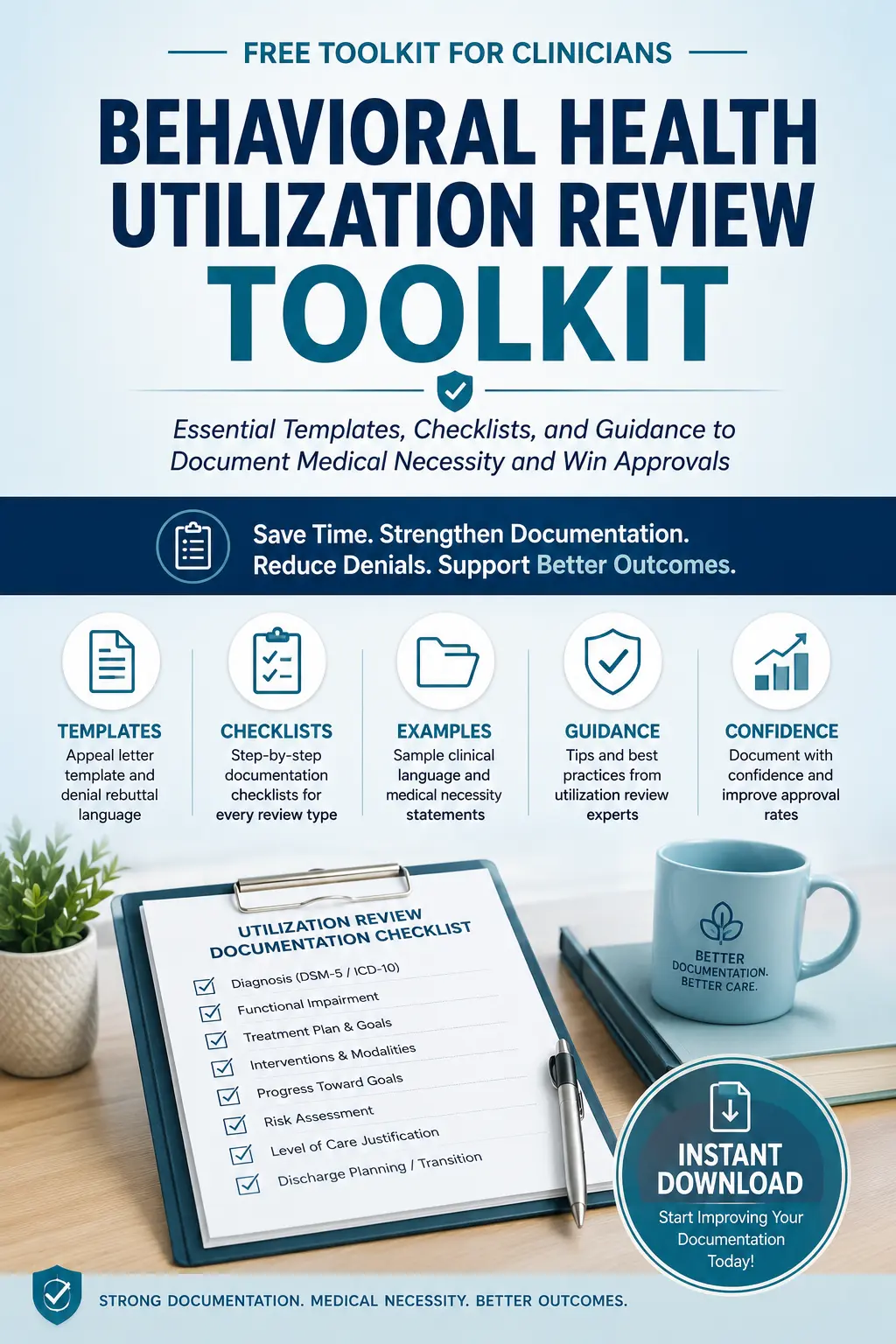
Get the Behavioral Health Utilization Review Toolkit
Download checklists, templates, sample note language, denial rebuttal guidance, and an appeal letter template to help strengthen documentation, support medical necessity, and reduce authorization denials.
- Pre-authorization documentation checklist
- Concurrent review prep worksheet
- Sample medical necessity language
- Common denial reasons and rebuttal language
- Denial appeal letter template
The following workflow illustrates how reviewers evaluate medical necessity through documentation. Every step — from diagnosis to progress tracking — helps support continued authorization and successful utilization review outcomes.
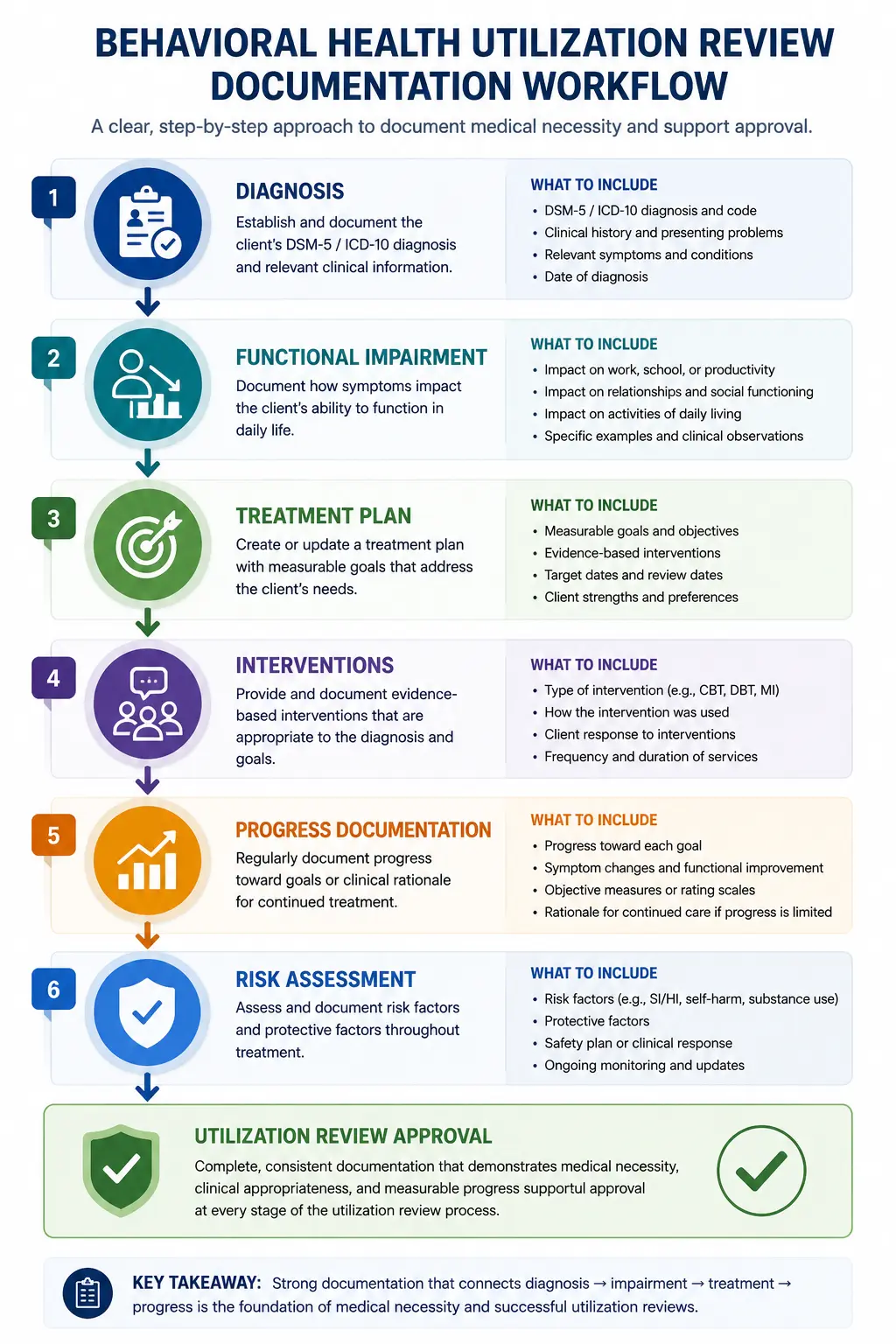
Successful behavioral health utilization reviews depend on documentation that clearly links diagnosis, functional impairment, treatment goals, interventions, and measurable progress. Missing any of these elements can weaken a medical necessity determination and increase the risk of authorization denials.
Watch this on-demand webinar for an overview of best practices for utilization reviews

Tips for Documenting with Utilization Review in Mind
Passing a behavioral health utilization review starts with documentation that clearly supports medical necessity. Reviewers look for evidence of functional impairment, measurable progress, appropriate interventions, and a clinical rationale for the level of care being provided. Whether you're documenting outpatient therapy, IOP, or PHP services, these utilization review documentation tips can help strengthen your notes, improve authorization outcomes, and reduce claim denials.
1. Align Notes with Diagnoses and Treatment Goals
Make sure each session note connects the intervention to the client’s diagnosis and goals from the treatment plan. Reviewers want to see consistency and purpose behind each session. A note that doesn’t tie back to the treatment plan looks like it was written in a vacuum.
INSTEAD OF
Client was tearful and discussed recent stress.
TRY
Client presented with tearfulness and hopelessness consistent with her MDD diagnosis. Discussed recent work-related stress contributing to worsening depressive symptoms and functional impairment, including inability to concentrate at work and withdrawal from family activities. Intervention targeted cognitive restructuring of catastrophic thinking patterns per treatment plan goal #2.
2. Highlight Functional Impairment
Functional impairment is the core of medical necessity. Use language that shows how the client’s symptoms are actively interfering with their daily life. Generic emotional descriptions like “anxious” or “depressed” are not enough on their own — always connect them to function.
Examples of functional impairment language:
- Unable to maintain employment due to panic attacks occurring 3–4 times per week
- Withdrawn from social and family interactions for the past 30 days
- Significant sleep disturbance (3–4 hours per night) impeding concentration and school attendance
- Unable to leave home unaccompanied due to agoraphobia symptoms
3. Demonstrate Progress or Justify Lack of It
Utilization reviewers expect either measurable progress toward treatment goals or a strong clinical justification for why progress is limited. No change without explanation is a denial waiting to happen.
✓ PROGRESS LANGUAGE
Client reports a 50% reduction in panic attacks since initiating exposure therapy three weeks ago. PHQ-9 score decreased from 18 to 12. Client has returned to a part-time work schedule.
⚠ JUSTIFICATION FOR LACK OF PROGRESS
Client remains emotionally dysregulated following recent disclosure of childhood trauma. Continued stabilization through DBT skills training is clinically indicated prior to trauma processing. Current focus on distress tolerance is appropriate given presentation; symptom reduction is not expected at this stage of treatment.
4. Document Interventions Clearly
Use specific, evidence-based intervention language. Avoid generic phrases like “talked about feelings,” “supportive counseling,” or “provided support” — these tell a reviewer nothing clinically meaningful.
INSTEAD OF
Supportive counseling provided.
TRY
Utilized cognitive restructuring to challenge maladaptive thoughts contributing to suicidal ideation. Client identified three evidence-based counter-statements and practiced self-monitoring using thought record worksheet.
5. Include Risk Factors When Relevant
When a client presents with suicidal ideation, self-harming behaviors, substance use, or other clinical risk factors, document them clearly and describe the specific interventions you used to manage the risk. Payers want to see that you are actively assessing and addressing risk — not just noting its presence.
EXAMPLE: RISK DOCUMENTATION LANGUAGE
Client endorsed passive suicidal ideation with no current plan or intent. Denied access to lethal means. Safety plan reviewed and updated during session. Client provided with crisis line resources. Clinician will follow up in 48 hours. Session frequency increased to twice weekly for continued monitoring and safety oversight.
This language documents the presence of risk, shows an immediate clinical response, outlines a follow-up plan, and directly supports medical necessity for continued care.
One of the most common reasons for authorization denials is insufficient documentation explaining why a higher level of care is necessary. The comparison below highlights the clinical and documentation differences between Intensive Outpatient Programs (IOP) and Partial Hospitalization Programs (PHP).
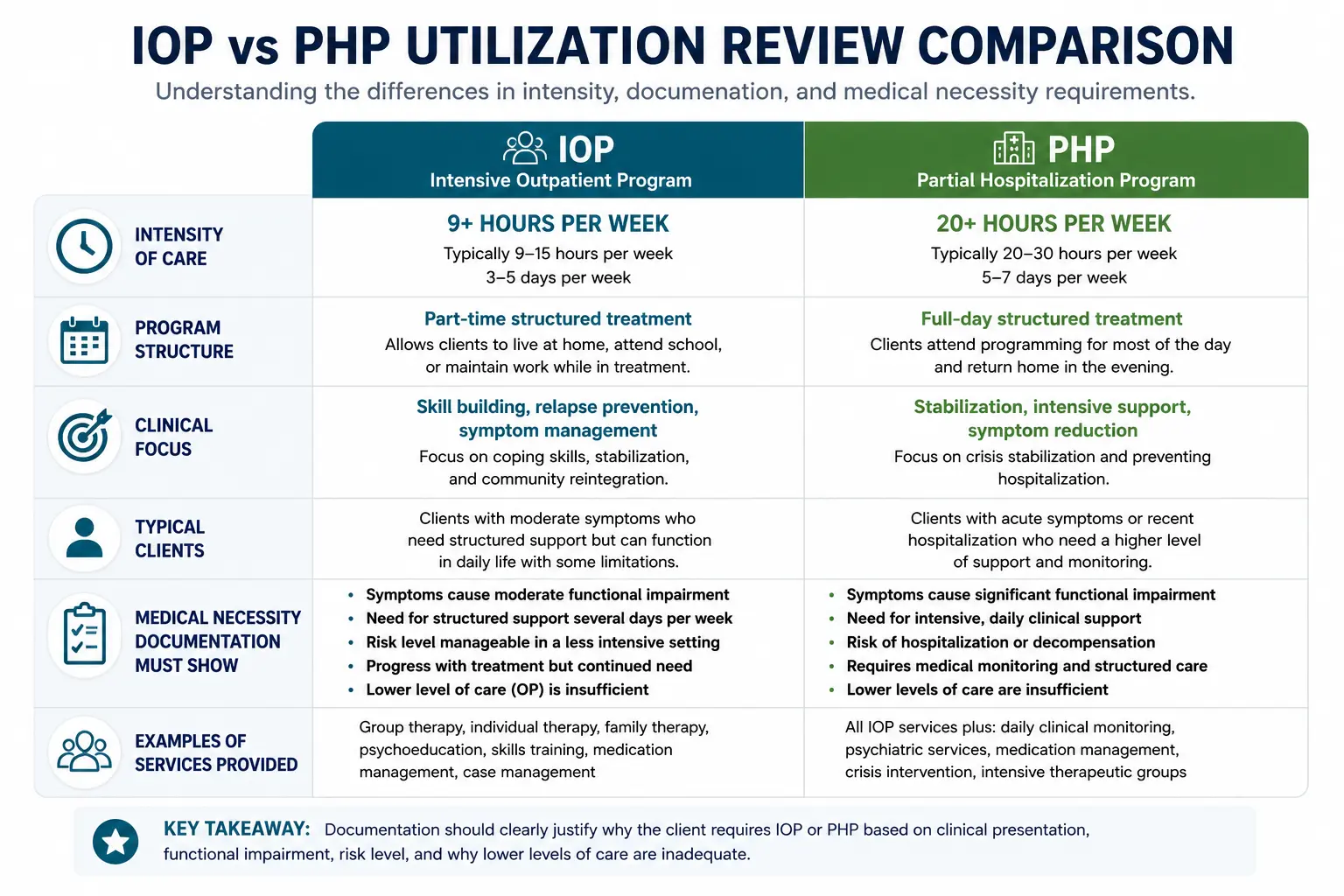
For both IOP and PHP programs, reviewers are evaluating more than symptom severity alone. Documentation should clearly demonstrate functional impairment, risk factors, prior treatment history, response to lower levels of care, and the clinical rationale for the requested level of care. Strong level-of-care justification is one of the most important factors in successful utilization review outcomes.
Utilization Review Tips for IOP and PHP Programs
Intensive outpatient programs (IOP) and partial hospitalization programs (PHP) face heightened scrutiny from payers. Because these represent higher-cost, higher-intensity levels of care, reviewers apply a more rigorous standard to medical necessity determinations. The general documentation tips above apply at all levels of care — but the following specifics are critical for IOP and PHP.
Document Level-of-Care Justification Explicitly
Do not assume that a diagnosis alone justifies IOP or PHP. Payers want to see clinical evidence that a lower level of care would be insufficient to stabilize the client. Your documentation must explicitly address why outpatient therapy is not appropriate.
EXAMPLE: IOP LEVEL-OF-CARE JUSTIFICATION
Client presents with daily panic attacks rendering him unable to leave his home for work or social activities. Outpatient therapy at one session per week has been insufficient to provide the daily structure, psychoeducation, and therapeutic contact needed for symptom stabilization. IOP level of care is clinically indicated. Client requires a minimum of 9 hours of structured group and individual treatment per week to achieve safe and sustainable functioning.
EXAMPLE: PHP LEVEL-OF-CARE JUSTIFICATION
Client presents with severe depressive symptoms, daily passive suicidal ideation, impaired self-care, and inability to maintain basic daily routines without structured support. Standard outpatient therapy and IOP are insufficient to provide the intensity of monitoring, therapeutic intervention, and psychiatric oversight needed at this time. PHP level of care is clinically indicated as the least restrictive setting appropriate to stabilize symptoms, support safety, and prevent hospitalization.
Track Attendance and Participation
IOP and PHP authorizations are frequently denied for “failure to engage” or “failure to meet program criteria.” Document session attendance, level of participation, and any barriers to engagement. If a client misses sessions, document why and what clinical steps were taken in response — such as a phone outreach, a clinical staffing, or a level-of-care reassessment.
Document Level-of-Care Transitions
When a client steps down from PHP to IOP, or from IOP to standard outpatient, document the clinical rationale for the transition. Include the specific criteria that were met to justify the step-down and the continued clinical needs that require ongoing care at the new level. Payers expect a clear narrative connecting the discharge from one level to the admission to the next.
Prepare Documentation for Each Authorization Period
Many payers conduct a utilization review at each authorization renewal — not just at admission. Build your documentation workflow so that every authorization period includes a clear clinical summary covering: current symptoms and functional status, progress toward treatment goals, updated treatment plan, attendance record, and the plan going forward. ICANotes’ Clinical Summary Generator can produce this packet automatically, compiling diagnoses, treatment plans, and session notes into a reviewer-ready document.
Utilization Review Documentation Checklist
Use this checklist before submitting documentation for any utilization review. Each item represents an element reviewers are looking for. A downloadable version with additional detail for IOP and PHP programs is included in the free toolkit.
Utilization Review Best Practices
Strong documentation is the foundation — but navigating the actual review process also requires preparation and a working knowledge of the system. Being prepared with best practices can make the difference between approval and denial. The following tips will help you navigate reviews confidently, advocate effectively for your clients, and ensure your notes stand up to payer expectations.
- Speak from the chart. Never offer opinions not reflected in documentation. Reviewers evaluate what’s written, not what you know.
- Know the difference between diagnosis and presenting problem. The diagnosis might be MDD, but the presenting problem — what makes continued treatment necessary right now — might be worsening suicidal thoughts or inability to function at work.
- Stay concise and clinically relevant. Reviewers want the current treatment episode. Stick to what’s clinically significant now.
- Be on time and prepared for concurrent reviews. Know your client’s attendance record, any medication changes, and the current treatment plan before you get on the call.
- Track authorizations proactively. Know when sessions are about to expire so you never miss a review window. Missed reviews often result in gaps in authorization.
- Ensure treatment plans and progress notes are aligned. Reviewers will flag inconsistencies between what the treatment plan says and what your notes reflect.
- Build strong discharge plans. Include continued goals, follow-up supports, crisis contacts, and step-down recommendations.
- Know the denial appeal process. Start with a peer-to-peer review and escalate to formal appeals with proper patient waivers when needed. See the FAQ section below for more detail.
FAQ: Behavioral Health Utilization Review
The questions below address the most common points of confusion clinicians encounter with utilization reviews. For a complete reference guide — including denial rebuttal language and an appeal letter template — download the free toolkit above.
How ICANotes Supports Documentation for Behavioral Health Utilization Reviews
When it comes to passing a behavioral health utilization review, the quality of your documentation matters — and ICANotes was built to make it easier. ICANotes is a behavioral health EHR designed to help clinicians write faster, more complete, and medically defensible notes that meet payer expectations.
Structured Templates Linked to Diagnoses
ICANotes automatically links clinical documentation to ICD-10 diagnoses and treatment goals, ensuring every note reflects medical necessity from the moment it’s written.
Built-In Behavioral Health Terminology
Choose from preconfigured, clinically relevant phrases tailored to behavioral health. This reduces vague language and makes it easier to document functional impairment and track progress over time — exactly what reviewers look for.
Integrated Treatment Plans
Treatment plans are built into the documentation workflow and can be easily updated to reflect changes in symptoms, functioning, and progress — keeping your notes and plans aligned, a critical requirement for concurrent reviews.
Clinical Summary Generator
Create complete utilization review packets with one click. ICANotes compiles diagnoses, treatment plans, and session notes into an exportable, reviewer-ready document — ideal for IOP and PHP authorization requests.
Managed Care Alerts
Set alerts for when managed care sessions are about to run out so no review opportunity is missed. Proactive authorization management prevents care gaps and denied claims.
Audit-Ready Notes
Every note generated in ICANotes is time-stamped, securely stored, and consistent with payer documentation standards — so you’re always prepared for retrospective reviews and audits.
Spend Less Time Preparing for Utilization Reviews
ICANotes helps behavioral health clinicians create documentation that supports medical necessity from the start. Structured templates, integrated treatment plans, utilization review packets, and managed care alerts make it easier to reduce denials and stay audit-ready.
- Create documentation linked to diagnoses and treatment goals
- Generate utilization review summaries with one click
- Track progress, functional impairment, and risk factors
- Stay ahead of authorization deadlines with managed care alerts
- Reduce documentation time while improving compliance
Start Your Free Trial
See how ICANotes can help you streamline documentation, support medical necessity, and prepare for utilization reviews with confidence.
Final Thoughts on Behavioral Health Utilization Review
Utilization reviews can feel like interruptions to care — but with strong documentation, they become opportunities to advocate clearly for your clients. Write with clinical specificity, keep your treatment plans current, and always tie your work back to functional impairment and medical necessity. The documentation you produce every day is your strongest asset in every review, audit, and appeal.
For clinicians who want to make this process faster and more consistent, ICANotes was built specifically to support behavioral health documentation workflows — from structured progress notes to automated utilization review packets.
Recent Posts


Dr. October Boyles
DNP, MSN, BSN, RN
Dr. October Boyles is a behavioral health expert and clinical leader with extensive expertise in nursing, compliance, and healthcare operations. With a Doctor of Nursing Practice (DNP) from Aspen University and advanced degrees in nursing, she specializes in evidence-based practices, EHR optimization, and improving outcomes in behavioral health settings. Dr. Boyles is passionate about empowering clinicians with the tools and strategies needed to deliver high-quality, patient-centered care.